The history of the modern planetarium in Canada goes back farther than we may be aware. Until the early 20th century, the word 'planetarium' could be understood to mean several different types of related instruments, including orreries, planispheres, astrolabe-faced astronomical clocks, etc. Notable surviving (or partially surviving and reconstructed) examples from the 17th and 18th centuries include the Gottorfer Riesenglobus (1650-1664), and Eise Eisinga's Planetarium in Franeker (constructed 1774-1781). Many others, such as Walker's Eidouranion (1781-ca. 1838), famous in their day, have disappeared without a trace (it should be noted that Wyld's Great Globe in Leicester Square, 1851-1862, was not a planetarium), Something of the impact of these various mechanical planetaria can be sensed from images such as Wright of Derby's A Philosopher Lecturing on the Orrery (1768). Taken as a whole, they represented a popular, successful, and long-lived technology.
In 1913, the Atwood Sphere, a 4.6-metre globe with 692 pinprick holes in its surface to illuminate the constellations for viewers stationed in its interior, was opened in Chicago (viewers of the Gottorf Globe viewed the constellations from inside the sphere as well, but in the 17th-century example they were painted on an unperforated surface). The technique of pinpricks for stars had been used for planispheres and constellation cards in the 19th-century, but here its application to a three-dimensional globe marked a step forward on the way to the electro-optical technology of the first planetarium projectors. A great deal of change has taken place in the century since the début of the Attwood Sphere, with "planetarium" coming to mean almost exclusively either the optical projection systems manufactured by companies such as Zeiss, Spitz, Minolta (now Konica Minolta), and Goto, or the successor computerized digital-projection systems as supplied by some of the same suppliers, as well as new entrants to the field.
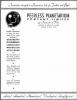
One of the forgotten chapters of the twentieth-century development of the planetarium is Canadian, and concerns the Peerless Planetarium Company, which originated somewhere in either Toronto, or Brantford (ON). Examples of the Peerless instruments may have made their way south of the border (e.g., to New York, or Philadelphia), but most surviving documentation relates to the installation of one at Forest Hill Village School in Toronto (it was set up in one of the school's gymnasiums).
The pretext for acquiring the instrument was the training of officers in navigation and other sciences at the end of the Second World War. It was described in the Toronto Star on 21 March 1945, the day after a field trip of the RASC Toronto Centre met in its dome. The Star mentioned the Peerless machine again in Frank Hogg's 'With the Stars' column on 30 March 1946, noting the importance of having a planetarium in Toronto relative to the Adler in Chicago, the Fels in Philadelphia, and the Hayden Planetarium in New York City. The visit of the Toronto Centre was written up in the Journal of the RASC in early 1946. The Hamilton Centre of the Society also visited the Peerless, on 6 May 1948, and were mentioned in the JRASC's annual reports in early 1949. Hamilton was one of the first cities to have a Spitz Model A-1 planetarium installed later that same year. This was about twenty years before the now-defunct McLaughlin Planetarium opened in Toronto in 1968, partly inspired by a bequest from RASC member Carl Reinhardt.
Some time after Hamilton Centre's visit to the Forest Hill School planetarium, the machine was disassembled, and subsequently disappeared. There are a few references in the early 1960s to a planetarium at Casa Loma (about a mile away from the Forrest Hill school), but that was documented as a Spitz system.
The Peerless Planetarium operated at a time when the definition of the word "planetarium" was on the way to its more constrained modern meaning. The Peerless was housed in a wooden cabinet that could be opened out. When it was on display, it included models of the Sun and Moon on rotating arms, and a globe of the Earth showing surface details and wind directions. It was set up in some kind of dome, but the dome seems to have been a pinprick-style affair, rather than a concave screen for to receive projected images. The technology used by Peerless seemed to be a combination of mechanical orrery, and pinprick starfields. From our perspective, it looked back to 18th and 19th century devices, rather than forward to cutting-edge mid-twentieth century ones. The demise of the Peerless Planetarium Company may have been in part attributable to its technology not being competitive with those marketed by Spitz and Zeiss. No intact, or partial examples of a Peerless Planetarium have yet been located.
PEERLESS PLANETARIUM
COMPANY LIMITED
121 Front Street West
Toronto, Ontario, Canada
PHONE ELGIN 1846
UNQUALIFIED COMMENDATION BY HIGHEST AUTHORITIES
DR. CLYDE FISHER—Curator in Chief. Department of Astronomy and the Hayden Planetarium. American Museum of Natural History, New York City: "I am intimately familiar with the Peerless Planetarium, having used it myself in my classes in Elementary Astronomy and Geography .... It lays the foundation of the essential basic causes of natural and human phenomena which every student should comprehend. . . . An excellent teaching instrument. Really I cannot speak too highly of it.... A wonderful teaching device . . . has a wide range of usefulness in teaching Astronomy, Meteorology, and Geography,"
DR. C. A. CHANT—David Dunlap Observatory. University of Toronto. Ontario, Canada: "I examined it with some care. It illustrated quite satisfactorily various phenomena of the solar system. ... To teach the motions of the celestial bodies, good models are almost indispensable,"
MR. JAMES E. KAVANAGH—Prominent New York City Business Executive: "I want to congratulate you on what you have done. I was very favorably impressed with the graphic manner in which you present to students the movements of the Sun, Moon, and Earth, together with the results that follow the various solar movements. You have something that is too good to keep under a bushel. It ought to be possible for every boy and girl, and millions of men and women, to have a proper appreciation of the way in which at least a portion of our wonderful universe functions,"
DR. GRIFFITH TAYLOR—Professor of Geography. University of Toronto. Ontario, Canada: ".. an apparatus, the Peerless Planetarium, for demonstrating a number of fundamental problems in Astronomy, Geography, and Allied Sciences, which seems to me of great merit."
DR. RALPH E. HORTON—Chairman, Standing Committee on Science. Board of Education. New York City: "Thank you again for demonstrating the device to us. I must admit that I was agreeably surprised by the way the performance of the Peerless Planetarium confirmed what you told me about it in advance. It is the most authentic, objective, exposition of the relations of the Sun, Earth, and Moon,and the consequences of their mutual motions, that I have ever seen:'
ROYAL ASTRONOMICAL SOCIETY OF CANADA—Resolution passed after full demonstration of the Peerless Planetarium: "Believing that the teaching of Geography would be greatly assisted by the use of the Peerless Planetarium, we commend it to the consideration of educational authorities."
MR. V. K. GREER—Chief Inspector of Public and Separate Schools. Province of Ontario. Canada: "The finest piece of educational apparatus I have seen,"
| Attachment | Size |
|---|---|
 Peerless-Planetarium.pdf Peerless-Planetarium.pdf | 4.76 MB |